

Designed with clinical teams for the babies who need skin-to-skin care most.
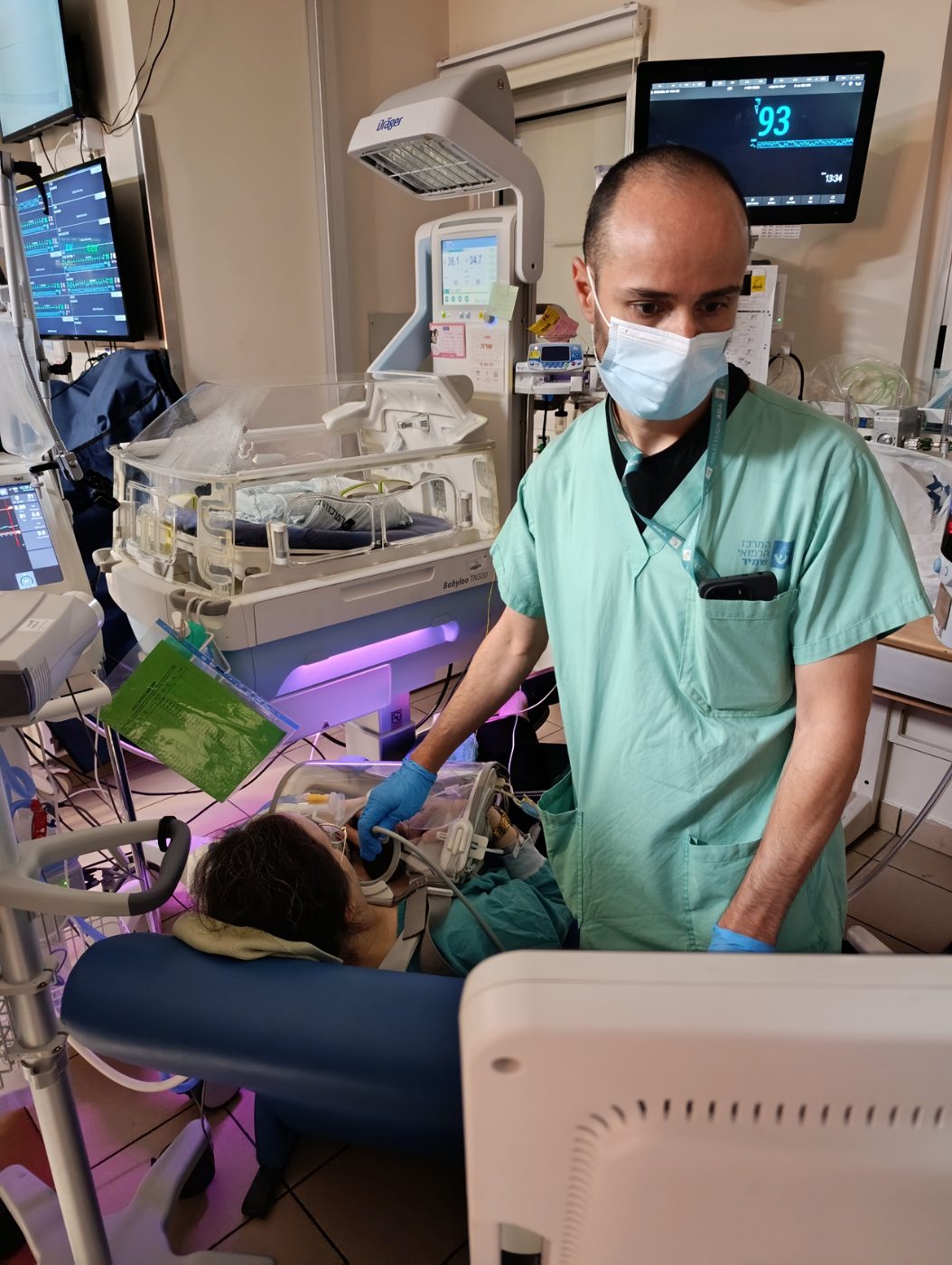
Over four years, we worked alongside hundreds of nurses, neonatologists, therapists and parents in high-level NICUs to make immediate, prolonged skin-to-skin care practical for the smallest preterm infants, without adding to your team’s workload.
The evidence
is established.
Delivering it is the challenge.
For extremely and very preterm infants, skin-to-skin contact starting in the first hours of life and lasting at least 8 hours a day is associated with fewer serious infections,1 more stable thermoregulation,1 improved neurodevelopment,2,3 and shorter length of stay.4 WHO recommends it for preterm and low-birth-weight infants.1
But for the most fragile infants, it’s also the hardest to deliver. Transfers put lines and thermal stability at risk. Warmth, humidity, and visibility are hard to maintain outside the incubator. And sessions are interrupted by routine care, procedures, and parent fatigue. Any one of these can delay or end a session.
Read the researchDesigned around every role in the NICU
From first demo to everyday practice
Questions clinicians ask
All questions →How does Skincubator fit with our existing kangaroo care practice?
It doesn’t replace it. Skincubator is the missing piece between birth and traditional skin-to-skin, designed to make it possible to start in the first hours of life and continue for hours at a time, for infants who would otherwise wait.
Which infants is it designed for?
Babies under 2000 g, including under 1000 g, from the day of birth, including those with arterial, umbilical, feeding, or airway lines, and those on CPAP, NIV, or invasive ventilation.
How many staff does a transfer take?
It’s designed for one nurse, in under three minutes. The transfer pad rolls beneath the baby, so the baby is not lifted by hand.
What about extubation and line dislodgement?
ET tubes, umbilical catheters, vascular lines, and respiratory circuits anchor to the frame with 5–10 mm of controlled slack. The frame takes the load, so the parent can shift or be repositioned without pulling on lines.
What happens if the baby needs urgent intervention?
The cover releases in one movement, lines are organized for one-handed access, and the baby can be returned to the incubator quickly using the same transfer pad.
Can routine care continue during a session?
Yes. Access ports allow routine care and selected procedures, and sessions can continue through phototherapy and pumping.
How is thermoregulation maintained?
The cover is designed to hold 70–90% relative humidity at 29–31 °C, using the parent’s body heat, infrared-reflective surfaces, and hydrophobic materials. In a published study it held temperature and humidity more steadily than traditional skin-to-skin care.
It looks bulky. Is it?
It looks bigger because it does more. Every part replaces something done by hand today: the pad replaces the lift, the anchors replace the tape, and the cover replaces the extra blankets and extra hands. Parents and staff in our studies reported more confidence and less fear of dislodging a line, which is what makes longer sessions possible.
How is infection control handled?
Every soft component is single-use, one per baby. Cleaning is part of the device’s regulatory validation testing.
See it in action.
Talk to our team. We’ll show you how it works and answer every question.
References +
1. World Health Organization. Recommendations for care of the preterm or low-birth-weight infant, 2022.
2. Travis KE, Lazarus MF, Scala M, et al. Skin-to-skin holding in relation to white matter microstructure in infants born preterm. Neurology, 2025;105(8):e214138. Stanford, 86 infants under 32 weeks: an average of 24 minutes of skin-to-skin a day. doi.org/10.1212/WNL.0000000000214138
3. Inpatient skin-to-skin care predicts 12-month neurodevelopmental outcomes in very preterm infants. The Journal of Pediatrics, 2024. Stanford, level IV NICU: families averaged about 17 minutes a day. PMC11514444
4. Narciso LM, Beleza LO, Imoto AM. The effectiveness of Kangaroo Mother Care in hospitalization period of preterm and low birth weight infants: systematic review and meta-analysis. Jornal de Pediatria, 2022;98(2):117–125. Twelve randomized trials: hospital stay 1.75 days shorter on average. doi.org/10.1016/j.jped.2021.06.004